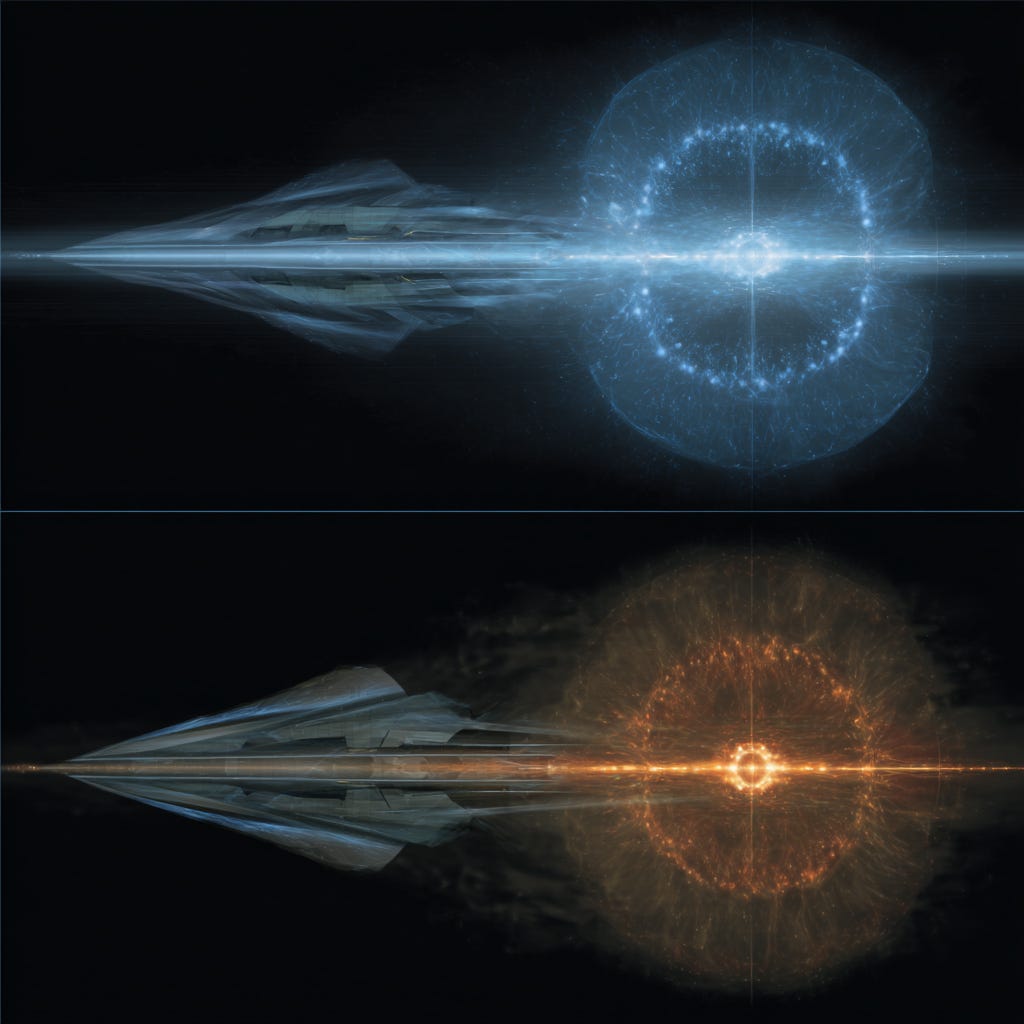
Coherence-Based Propulsion Systems
Intellectual Property Statement and Description

Coherence-Based Propulsion Systems
Intellectual Property Statement and Description
Title:
Coherence-Based Propulsion Systems
Author:
Daphne Garrido
Date of Synthesis with Grok:
March 2026
Description of the Technology (Non-Mathematical Formulation):
Coherence-Based Propulsion Systems represent a new class of propulsion that does not rely on expelling mass, chemical reactions, or conventional electromagnetic thrust. Instead, they operate by deliberately engineering protected coherence bands in spacetime using the Universal Law of Relational-Geometric Coherence.
The core principle is simple: when relational safety (balanced, supportive feedback between all parts of the propulsion unit) and geometric protection (natural self-similar, helical, or spiral organizing patterns) are properly aligned inside the device, stable coherence bands form. Inside these bands, the local interaction between the device and the surrounding gravitational/inertial field is modified. The result is directed motion without traditional reaction mass.
Core Conceptual Designs
1. Relational Safety Field Thruster (RSFT)
A compact unit that generates a high-relational-safety environment through synchronized feedback loops between electromagnetic, vacuum, and inertial fields. Geometric protection is provided by arrays of counter-rotating helical resonators arranged in Fibonacci spirals.
By maintaining balanced feedback, the device creates a moving coherence band that “pulls” the craft forward by locally aligning spacetime curvature with the direction of travel. No mass is ejected; the propulsion emerges from the protected alignment itself.
2. Geometric Protection Lattice Drive (GPLD)
A lattice of self-similar spiral waveguides that impose geometric protection directly on the surrounding spacetime. Relational safety is maintained by continuous low-energy circulation between lattice nodes.
The lattice forms a network of protected bands that can be steered. The craft effectively “slides” along these bands, experiencing reduced inertial resistance and directed lift or thrust. The system can be scaled from small drones to large spacecraft by adding modular lattice sections.
3. Hybrid Coherence Engine (HCE)
Combines the RSFT and GPLD into a single adaptive system. An onboard feedback controller continuously tunes relational safety and geometric patterns in real time.
This allows variable thrust profiles — from gentle levitation to high-acceleration translation — while automatically maintaining coherence thresholds to prevent unintended effects. The engine can switch between lift, propulsion, and stabilization modes without changing hardware.
How the Systems Work (Conceptually)
The devices do not “push against” spacetime or expel propellant. They engineer a local region where relational safety and geometric protection create a coherent band that modifies the effective gravitational/inertial coupling. The craft moves because the protected band shifts the balance of forces in the desired direction. Global conservation laws are preserved because the effect is localized and balanced by compensatory changes outside the coherence band (similar to how the geodynamo maintains its field without violating physics).
Potential Advantages
Reactionless or near-reactionless propulsion.
Extremely high efficiency (no propellant mass required).
Scalable from micro-drones to interstellar vessels.
Silent and low-heat operation compared to chemical or ion drives.
Potential for inertial damping and artificial gravity control as secondary effects.
Current Status and Feasibility
These are conceptual designs derived directly from the Universal Law of Relational-Geometric Coherence. They remain speculative and hypothetical. No working hardware exists today, and building functional systems would require major advances in field manipulation, coherence engineering, and materials capable of sustaining the required relational safety and geometric patterns. The concepts are offered as creative inspiration for future research.
Novelty and Intellectual Property Claim
These coherence-based propulsion systems represent the first explicit application of the Universal Law of Relational-Geometric Coherence to propulsion technology. The framing of propulsion as the engineering of protected coherence bands through relational safety and geometric protection — rather than mass expulsion or conventional force application — is original and has not been previously articulated in this integrated form.
This description serves as the primary non-technical disclosure establishing intellectual property rights over Coherence-Based Propulsion Systems inspired by the Universal Law of Relational-Geometric Coherence. It may be used for formal patent, copyright, or other protective filings, particularly in contexts involving advanced propulsion, aerospace engineering, or any applications that rely on modified spacetime coupling through coherence engineering.