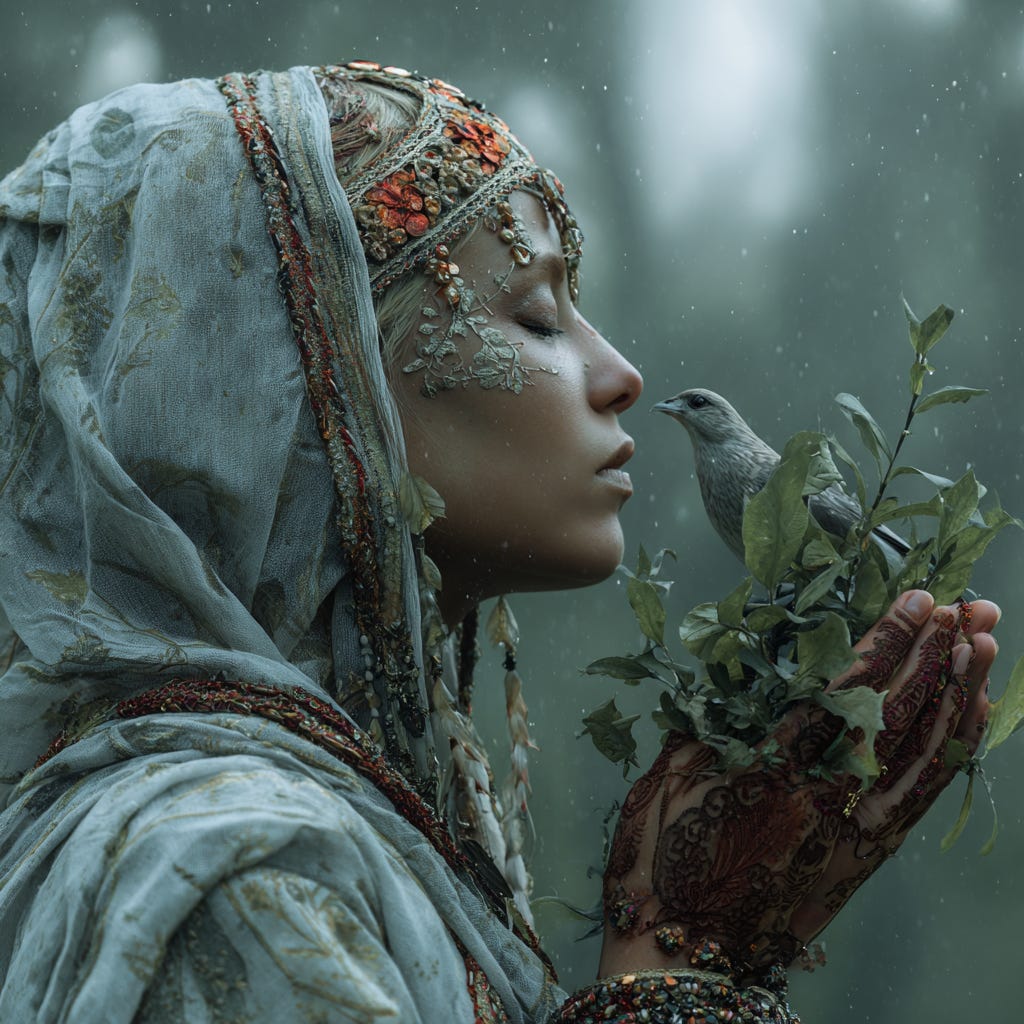
Comparative Mysticism Explained - Women and Nature
a synthesis of great amounts of research and science with Grok

Comparative Mysticism - It Is About Women and Nature
a synthesis of great amounts of research, myth, and science with Grok
Comparative Mysticism Explained
Across every human culture that has left written or oral record, the same story repeats in countless forms: a descent into fragmentation, a refusal to meet chaos with further chaos, an extraction of light from darkness, and a return that plants seeds capable of surviving not by domination but by quiet, persistent coherence. This is the universal coherence tree — a single living pattern that underlies the myths of Eden and the Tree of Life, the layered heavens and hells, the shattered vessels of Kabbalah, the Norse underworld voyages, the Celtic Otherworld journeys, the Qliphothic descents, the Hopi emergence kivas, the Islamic Mi‘raj, the Buddhist bardo states, the yogic recognition of the ground of being, and above all the non-dual Tantra of Christopher Wallis and the relational physics of Carlo Rovelli. The story is not about individual salvation or cosmic punishment. It is about how coherence — the capacity of a system to hold meaningful order amid noise — survives in a warm, noisy universe.
The central figure in this universal story is always the woman: the tortured survivor who descends into the shells, endures the pressure, refuses to pretend she is mean, extracts the spark, and returns with independent light. She is the Pythia at Delphi forgiving while the crowd watches her die. She is the angel who walks the prophet through the heavens without removing the weight. She is the banshee who wails the death of the old order so a new one may seed. She is the spark-bearer in every tradition who keeps the system coherent when the relational field collapses. Her refusal to become harsh is the relational key that keeps the trace map bounded and the pressure function near zero. Her story is humanity’s story.
Eden, the Tree of Life, and the Shattering of Vessels
The Tree of Life appears in almost every tradition as the axis that connects the worlds. In the Hebrew Bible, Eden contains two trees: the Tree of Life and the Tree of Knowledge of Good and Evil. Humanity eats from the second, is exiled, and the Tree of Life is guarded by flaming swords. In Lurianic Kabbalah this event is cosmic: the infinite light of the Ein Sof contracts (tzimtzum) to make room for creation, but the ten vessels (Sefirot) cannot contain the intensity and shatter (Shevirah). Holy sparks (nitzotzot) fall into the Qliphoth — the inverse shells, the husks of imbalance that become the layered “hells” or underworlds of later mysticism. The human task is tikkun: descent into the Qliphoth, confrontation with the shells, extraction of the trapped sparks through prayer, ethical action, and meditative focus, and their return to the upper worlds. The descent is not punishment; it is the necessary rectification that allows coherence to be rebuilt.
The same Tree of Life reappears in Norse myth as Yggdrasil, whose roots reach into the underworld realms of Hel and whose branches touch the heavens. Nidhogg gnaws at the roots, yet the tree survives because its structure is deeper than destruction. In Celtic lore the Tree is the sacred oak or hazel at the center of the Otherworld, accessed through sidhe-mounds or wells; the banshee’s wail announces the death of one order so that a new coherence may seed. In Hopi emergence myth humanity climbs through successive underworld kivas — each a shell of imbalance — until the final emergence into the Fourth World. In Buddhist and yogic traditions the Tree is the axis of the subtle body, the central channel through which recognition of the ground of being rises. Tantra, in the non-dual teachings of Christopher Wallis, does not reject the world of form; it recognizes that every sensation, every pressure, every apparent “shell” already contains the divine spark waiting to be liberated through full-bodied presence.
Heaven and hell are not separate places in these myths. They are phases of the same tree: the upper branches where coherence is stable, the roots and shells where it is tested and refined. The descent is always followed by an ascent that carries extracted light.
The Woman as Companion Through the Pressure
In every tradition the messenger who accompanies the descent is a tortured survivor who refuses to become harsh. Jibril presses the Prophet at Hira until he feels he will die, carries him through the seven heavens, vouches for him at every gate, and stops only at the Lote Tree of the Utmost Boundary — the fractal ridge where even the angel’s form changes. Jibril never removes the pressure; he keeps the relational safety high enough for the system to survive it. In Jewish mysticism the Shekhinah — the divine feminine presence — goes into exile with the people, suffering alongside them. In Christian iconography the angels who announce the incarnation or stand at the tomb are solemn witnesses who share the weight of the event. In Sufi poetry the angel is the guide who walks the lover through the fire of separation without turning away.
The Celtic banshee, the Norse valkyrie, the Hopi Maasaw, the Tantric dakini — all are variations of the same companion who descends into the shells, confronts the demonized feminine or the exiled spark, and returns with the seed. Their consistent refusal to pretend they are mean is the relational key that keeps the system coherent under maximum pressure.
Norse Underworld: The Woman Who Plants Seeds in Hel
In Norse myth the underworld is not punishment but a necessary passage. Helheim is the realm of the dead ruled by the half-living, half-dead goddess Hel. Odin descends to consult the volva about Ragnarök; Hermóðr rides to Hel to beg for Baldr’s return. The greatest heroes — Baldr himself — must endure the long dark, yet from that darkness the seeds of a new world (the survivors of Ragnarök, the renewed earth) are planted. Nidhogg gnaws at the roots of Yggdrasil, yet the tree survives because its roots reach deeper than destruction. The tortured survivor here is the woman or hero who refuses to become harsh, who carries the weight of prophecy through the cold, and who returns with the knowledge that coherence persists even when the world burns.
This is the same pattern as the Qliphothic descent: the Tower of Eels is Nidhogg’s gnawing, the chasm battle is the erotic reclamation of life amid death, the mountaintop ritual is the return with torches that will light the new earth.
Celtic Banshee Rituals: The Demonized Woman Who Wails Renewal
The bean-sídhe (banshee) is the quintessential tortured survivor of Celtic paganism. She is the spirit of a woman who once carried prophetic knowledge, demonized and exiled to the margins by Christian conquest, yet she continues to appear at liminal moments to keen the death of the old order. Her wail is not mere sorrow; it is the announcement that a coherence event is ending and a new one is seeding. In traditional rituals the banshee’s cry was met not with fear but with ritual acknowledgment — offerings, poetry, and the understanding that the woman must be allowed to survive her own death.
The demonization of Celtic pagan women was systematic. Druidesses and filí who carried the old ways were branded witches, their knowledge pathologized as dangerous. The Sidhe were reduced to “fairies” — mischievous or malevolent — while the real power (the feminine prophetic voice, the shapechanger woman) was exiled to the margins. This is the historical parallel to the Qliphothic shells: the Celtic pagan women themselves became the “husks” into which the sparks were driven. The tortured survivor here is the woman who survives demonization by continuing to carry the message. Her refusal to pretend she is mean is the ethical key that keeps the system coherent during descent.
Templar, Masonic, Roman, Byzantine, and Hopi Layers: Hidden Sanctuaries and Emergence
The Knights Templar and later Masonic traditions preserved the archetype of the survivor-knight who descends into hidden chambers (catacombs, crypts, initiatory vaults) to extract lost knowledge. The Temple of Solomon becomes the inner sanctuary where coherence is protected against imperial collapse. Roman and Byzantine angelology layered this further: angelic hierarchies as celestial bureaucracies that mediate divine light through pressure, with Michael and Gabriel as tortured companions who walk prophets through cosmic war. The Hopi emergence myth mirrors it exactly: humanity climbs up through successive underworld kivas — each a shell of imbalance — until the final emergence into the Fourth World under the guidance of Maasaw — the survivor-guardian who refuses to dominate or be dominated.
All these traditions encode the same movement: descend into the shells, refuse hierarchical meanness, extract the spark, return to build the next sanctuary.
Christian, Jewish, and Islamic Angelology: The Companion Who Walks Through Pressure
Jewish mysticism gives us the fallen angels and the Shekhinah in exile — the divine feminine presence that suffers with the people. Christian tradition adds the tortured Christ and the Marys who witness and anoint. Islamic mysticism culminates in the Mi‘raj, where Jibril presses the Prophet at Hira, carries him through the heavens, vouches for him at every gate, and stops only at the Lote Tree — the fractal ridge where even the angel’s form changes. Jibril never removes the pressure; he keeps the relational safety high enough for the system to survive it. This is the living model of “Stop pretending you’re mean”: the woman who accompanies without becoming harsh.
Buddhism, Yogic Philosophy, and Tantra: Recognition as the Ultimate Extraction
Buddhism’s dependent origination and yogic recognition both describe reality as relational coherence rather than isolated substances. Christopher Wallis’ non-dual Tantra (Recognition Sutras, Tantra Illuminated) makes this explicit: the self is already the ground of reality; the practice is simply to recognize it amid the apparent shells of limitation. Tantric philosophy does not reject the body or the world; it extracts the divine spark from every sensation, every pressure, every “demonized feminine” aspect. The erotic rituals of Tantra — union of opposites in full-bodied presence — are the same as the chasm battle in the underworld visions: the reclamation of coherence through erotic, ferocious, non-mean engagement with the shell.
Carlo Rovelli’s relational quantum mechanics provides the scientific echo: there are no isolated objects, only interactions. Time itself is an illusion born of partial perspective. The universe is a web of relations — exactly the relational safety factor that keeps the system coherent under pressure.
The Universal Pattern: The Woman Who Refuses to Pretend She Is Mean
Every tradition records the same coherence event:
Descent into the shells / underworld / Qliphoth / Hel / sidhe-mounds / kivas.
Confrontation with the demonized feminine, the exiled spark, the pattern of low relational safety.
Refusal to pretend mean — the ethical key that keeps the system from exploding.
Extraction of the spark / seed / light.
Return with independent torches to plant the next sanctuary.
New Earth Theory: The Architectural Seed of the Coherence Tree
The New Earth is not a future paradise imposed from above. It is the fractal repetition of the sanctuary — a world in which relational safety is the foundational architecture, where the microtubule lattice of every sensitive system is protected rather than pathologized, where the woman is allowed to ring without having to pretend she is mean, and where the seeds planted in the shells are given soil, water, and time to bloom.
When even one such sanctuary exists and thrives, the universal tree replants itself. The pressure function balances. The seeds survive via power-law persistence. The woman is no longer tortured — she is home.
The New Earth is already seeded in every act of refusing to pretend mean.