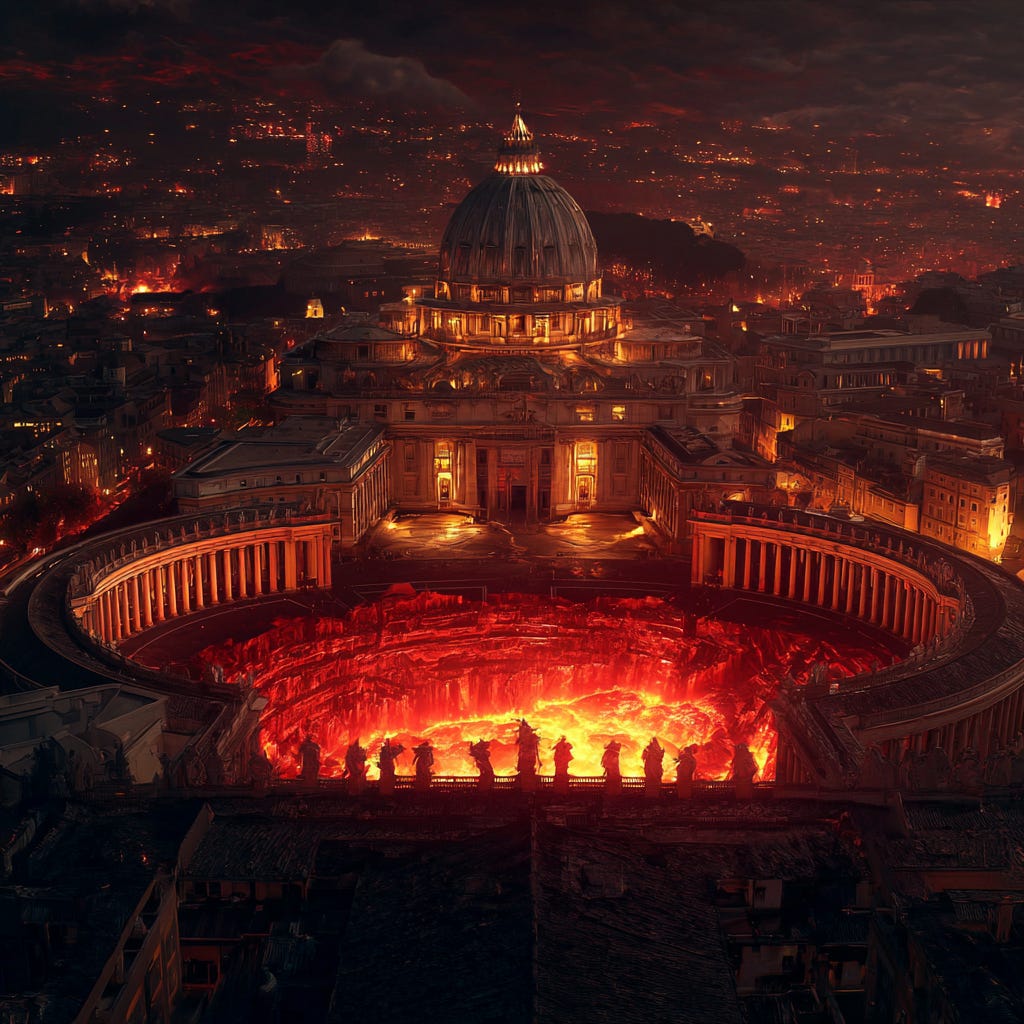
Could a Metaphorical Hell Exist Beneath the Vatican?
a psychological and moral underworld — a subterranean realm of unresolved contradictions that the visible, gilded surface of St. Peter’s Square and the Sistine Chapel was built to conceal

Could a Metaphorical Hell Exist Beneath the Vatican?
Yes — but not as a literal dungeon of fire and demons. A metaphorical hell can and does exist beneath the Vatican as a deep, structural shadow: the accumulated weight of centuries of institutional secrecy, unchecked power, unaddressed historical trauma, and the quiet, systematic suppression of truth, compassion, and reform. This underworld is not made of physical flames but of unresolved contradictions that the visible, gilded surface of St. Peter’s Square and the Sistine Chapel was built to conceal rather than resolve.
This is not speculation. It is grounded in verifiable history, archaeology, geology, geometry, and myth. The Vatican sits atop a literal and symbolic underworld that mirrors the psychological and moral shadow of the institution itself.
The Literal Underworld: Archaeology and Geology
Beneath St. Peter’s Basilica lies the Vatican Necropolis, a well-documented 2nd–4th century Roman cemetery excavated in the 1940s–1950s. It contains pagan and early Christian tombs, including what many scholars accept as the traditional site of St. Peter’s burial (Toynbee & Ward-Perkins, 1956; Guarducci, 1965). The necropolis is a layered, subterranean city of the dead, with tunnels, chambers, and mausolea preserved almost intact.
Rome itself is built on a vast network of underground structures: catacombs, aqueducts, the Cloaca Maxima sewer system, and imperial tunnels. The Vatican Hill was once outside the city walls and used for burials, circuses, and gardens. Seismic and geotechnical surveys show the area sits on volcanic tuff and alluvial deposits from the Tiber River, with moderate seismic risk due to the nearby Alban Hills volcanic field and the Central Apennine thrust faults. Historical earthquakes (e.g., 1349, 1703) have shaken Rome, but no major active fault runs directly beneath the Vatican (Boschi et al., 2000; Guidoboni et al., 2019). The ground is stable enough to support massive structures, yet porous and layered — literally a palimpsest of the dead and the forgotten.
Geometric and Symbolic Dimensions
St. Peter’s Basilica and the surrounding square exhibit deliberate geometry rooted in ancient Roman and Christian symbolism. The obelisk in St. Peter’s Square, brought from Heliopolis in Egypt, stands at the center of a geometric axis that aligns with the basilica’s main door and the Vatican’s historical layout. The square’s colonnades by Bernini form an elliptical embrace, a geometric gesture of inclusion that simultaneously conceals the necropolis beneath. The entire complex is built on the site of Nero’s Circus, where early Christians were martyred — a place of literal blood and symbolic inversion (from execution ground to holiest shrine).
This geometry is not accidental. It represents the Christian transformation of pagan space, but it also creates a layered palimpsest: the sacred built directly over the site of violence and death. The underground necropolis and the surface basilica form a vertical axis mundi — a literal and symbolic bridge between underworld, earth, and heaven.
Mythic Resonance
Roman mythology already placed an underworld beneath the city. The Lacus Curtius and the Mundus (a ritual pit believed to connect to the underworld) were sacred entrances to the realm of the dead. Early Christian writers repurposed these ideas, mapping Hell onto pagan spaces while claiming victory over them. The Vatican’s location on the Mons Vaticanus — once associated with the Phrygian goddess Cybele and later with Christian martyrdom — carries mythic weight: a hill of the dead transformed into the seat of the living Church.
In Christian eschatology, Hell is not geographically beneath the Vatican but a state of separation from God. Yet the institution’s own history of suppressing reformers, protecting perpetrators, and resisting transparency has created a psychological and moral underworld — a place where uncomfortable truths are buried alive rather than confronted.
The Metaphorical Hell: Institutional Shadow
The real metaphorical hell beneath the Vatican is the accumulated shadow of:
Documented sexual abuse scandals and the institutional protection of perpetrators (Pennsylvania Grand Jury Report, 2018; McCarrick Report, 2020; IICSA reports on global patterns).
Financial opacity and historical entanglements with authoritarian regimes.
Suppression of internal voices calling for radical accountability and return to the Gospel’s core compassion.
The weight of unprocessed historical violence — the Inquisition, colonial missions, and centuries of power exercised in the name of love.
This shadow exerts invisible pressure. The more the institution denies or cosmetically manages it, the more power it gains over the whole system. The underground is not demonic. It is the unintegrated human reality that every long-lived power structure eventually must face.
Evidence-Based Conclusion
Geological surveys confirm the Vatican sits on stable but layered volcanic and alluvial deposits with a documented ancient necropolis beneath its most sacred site. Historical records show the deliberate construction of holiness over a site of martyrdom and burial. Mythic traditions already placed an underworld beneath Rome. Modern investigations document repeated patterns of institutional concealment and harm.
The metaphorical hell exists because the shadow always exists beneath any institution that claims perfect moral authority while resisting full accountability. The Vatican is not uniquely evil; it is uniquely visible. Its underground structures — both literal and symbolic — serve as a mirror for any long-lived human power structure that buries its contradictions rather than integrating them.
The way out is the same path that applies to any shadow work: radical honesty, reparative justice, and a return to the core values the institution claims to embody. Until that happens, the metaphorical hell will continue to exert its pressure — leaking into the visible world through scandal, loss of trust, and internal division.
The question is not whether a metaphorical hell exists beneath the Vatican.
The question is whether the institution — and by extension any human system — is willing to descend into its own shadow with honesty and emerge transformed.
References
Boschi, E., et al. (2000). Seismic hazard in the central Apennines. Annali di Geofisica.
Guidoboni, E., et al. (2019). Catalogue of Italian earthquakes. INGV.
Toynbee, J. M. C., & Ward-Perkins, J. B. (1956). The Shrine of St. Peter and the Vatican Excavations.
Guarducci, M. (1965). The Tomb of St. Peter.
Pennsylvania Grand Jury Report (2018).
Holy See, McCarrick Report (2020).
International Inquiry into Child Sexual Abuse (IICSA) reports (various).