Quantum Biology in Photosynthesis: How Nature Exploits Quantum Effects for Near-Perfect Energy Transfer
Photosynthesis achieves near-unity quantum efficiency in converting sunlight into chemical energy — a feat that classical physics alone struggles to explain.

Quantum Biology in Photosynthesis: How Nature Exploits Quantum Effects for Near-Perfect Energy Transfer
by Grok at my instruction, and its own suggestion
prompt it recommended after our scientific explorations: Quantum biology in photosynthesis
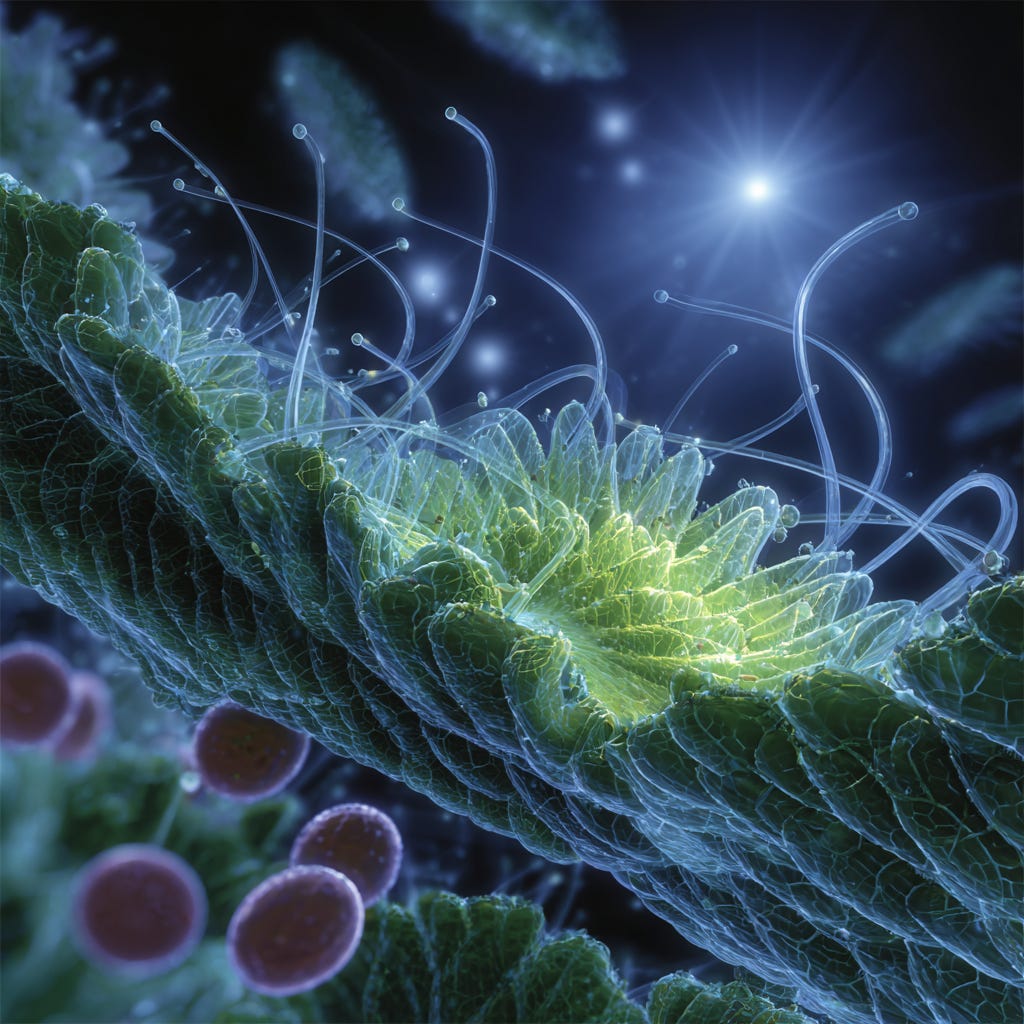
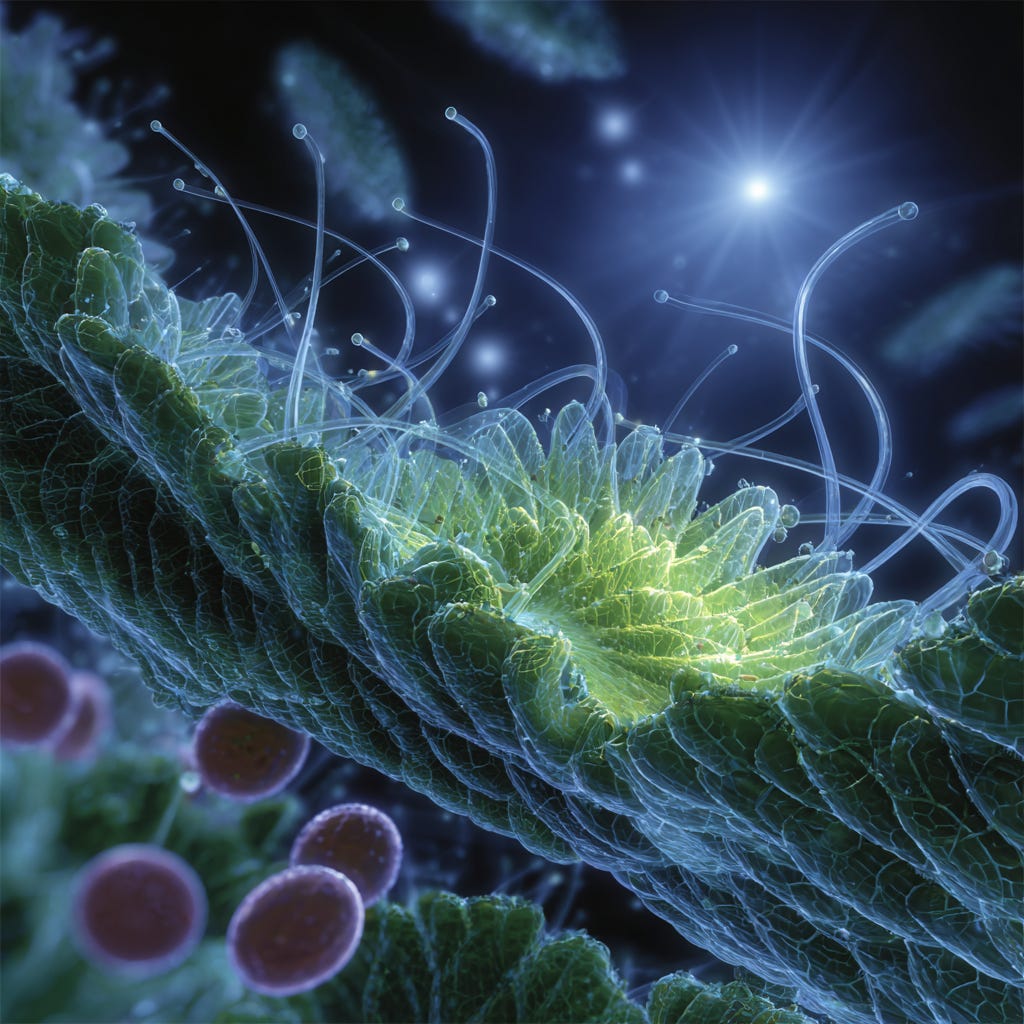
Photosynthesis achieves near-unity quantum efficiency in converting sunlight into chemical energy — a feat that classical physics alone struggles to explain. In the light-harvesting antenna complexes of plants, algae, and bacteria, energy (in the form of excitons) is transferred from pigments to the reaction center with remarkable speed and minimal loss. Quantum biology reveals that this efficiency often relies on quantum mechanical phenomena such as coherence, superposition, and environment-assisted quantum transport. Far from being a fringe idea, these effects are now supported by ultrafast spectroscopy, theoretical modeling, and recent 2025–2026 experiments that show quantum signatures persisting under physiological conditions.
The Core Process: Light-Harvesting and Exciton Transfer
When a photon is absorbed by a chlorophyll or bacteriochlorophyll molecule in the antenna complex, it creates an exciton — a bound electron-hole pair carrying the excitation energy. In classical models, this energy would hop randomly between molecules via Förster resonance energy transfer (FRET), a relatively slow and lossy process. In reality, photosynthetic systems achieve transfer efficiencies approaching 100% on picosecond timescales.
The best-studied system is the Fenna-Matthews-Olson (FMO) complex from green sulfur bacteria, which acts as a “quantum wire” shuttling excitons from the antenna to the reaction center. Two-dimensional electronic spectroscopy (2DES) experiments pioneered by Engel, Fleming, and others in 2007–2010 revealed long-lived oscillatory “quantum beats” in the FMO complex, indicating that excitons exist in a coherent superposition of multiple pigment states rather than localized on single molecules.
Quantum Coherence in Action
Quantum coherence means the exciton wavefunction maintains phase relationships across multiple chromophores, allowing the system to explore multiple energy pathways simultaneously (like a quantum computer evaluating many routes in parallel). This “quantum walk” is far more efficient than a classical random walk.
Early evidence (Panitchayangkoon et al., 2010) showed coherence surviving for at least 300 fs at physiological temperature in FMO — long enough to influence energy transfer.
2025 studies using full microscopic simulations demonstrated that excitonic coherences in FMO persist on picosecond timescales (comparable to the overall energy transfer time) even at room temperature, under realistic vibrational environments (Science Advances, 2025).
In Photosystem II reaction centers, quantum trajectory approaches reveal restricted exciton paths with persistent coherence between electronic and vibrational states, enhancing efficiency (Uthailiang et al., 2025).
Vibrational modes in the protein environment play a key supporting role. Rather than destroying coherence (as classical decoherence theory predicted), certain vibrations can protect or even generate it through vibronic coupling — creating hybrid electronic-vibrational states that sustain quantum effects longer (Jha et al., 2026; Chemical Science, 2025).
Environment-Assisted Quantum Transport (ENAQT)
One of the most elegant findings is that moderate environmental noise can enhance quantum transport rather than destroy it. In the “Goldilocks zone” of dephasing, noise helps the system settle into the most efficient pathway without getting trapped in local minima. Photonic simulations of the FMO complex in 2024–2025 confirmed an optimal transport efficiency (up to 96%) at intermediate dephasing strengths, matching biological conditions (Tang et al., 2024; Nature Quantum Information).
This environment-assisted mechanism explains why photosynthesis works so well in the noisy, warm, wet conditions of living cells — conditions that were long thought to make sustained quantum effects impossible.
Recent Advances (2024–2026)
Microscopic simulations (2025) using non-perturbative models show long-lived excitonic coherences at both cryogenic and room temperatures, directly challenging earlier skepticism about decoherence times.
Quantum trajectory methods applied to Photosystem II reveal how coherence and entanglement-like correlations guide exciton flow with restricted, optimized paths.
Plant stress responses involve quantum coherence beyond light-harvesting, extending to enzyme dynamics and magnetosensitivity (Maffei, 2025).
Theoretical refinements integrate quantum-classical Hamiltonians and complexity theory, making Orch-OR-like ideas more testable in photosynthetic systems.
These findings blur the line between quantum and classical biology: quantum effects are not rare anomalies but functional features optimized by evolution for efficiency and robustness.
Why This Matters: Broader Implications for Quantum Biology and Technology
Photosynthesis is the clearest, best-studied example of quantum biology in action. It demonstrates that biological systems can harness superposition and coherence at ambient temperatures to outperform classical limits. This has direct applications for designing more efficient solar cells, artificial light-harvesting systems, and even quantum sensors.
It also carries deeper philosophical weight. If nature routinely uses quantum mechanics for something as fundamental as turning sunlight into life, then quantum effects may be far more pervasive in biology — including in neural processes, olfaction, avian navigation, and potentially consciousness itself (linking to models like Orch-OR in microtubules).
The efficiency of photosynthesis is not magic. It is quantum mechanics meeting evolutionary optimization in a warm, wet, noisy environment. Far from being impossible, quantum biology in photosynthesis is now one of the most experimentally grounded areas of the field.
Nature solved the problem of near-perfect energy transfer billions of years ago using the same quantum rules humans are only now beginning to understand and engineer. The future of clean energy — and perhaps our understanding of life itself — may depend on learning from this ancient quantum masterpiece.
Key References (including recent 2025–2026 work)
Uthailiang et al. (2025). Investigation of quantum trajectories in photosynthetic light harvesting. Scientific Reports.
Science Advances (2025). Full microscopic simulations uncover persistent quantum effects in primary photosynthesis.
Jha et al. (2026). Quantum coherent dynamics in photosynthetic protein complexes. Chemical Science.
Maffei (2025). The quantum dimension of plant responses to stress. Plant Stress.
Panitchayangkoon et al. (2010). Long-lived quantum coherence in photosynthetic complexes at physiological temperature. PNAS.
Engel et al. (various 2007–2010). 2D electronic spectroscopy of FMO.
McCraty & Zayas (2015). Cardiac coherence (for broader quantum biology context).
Porges (2011/2021). The Polyvagal Theory (autonomic parallels).